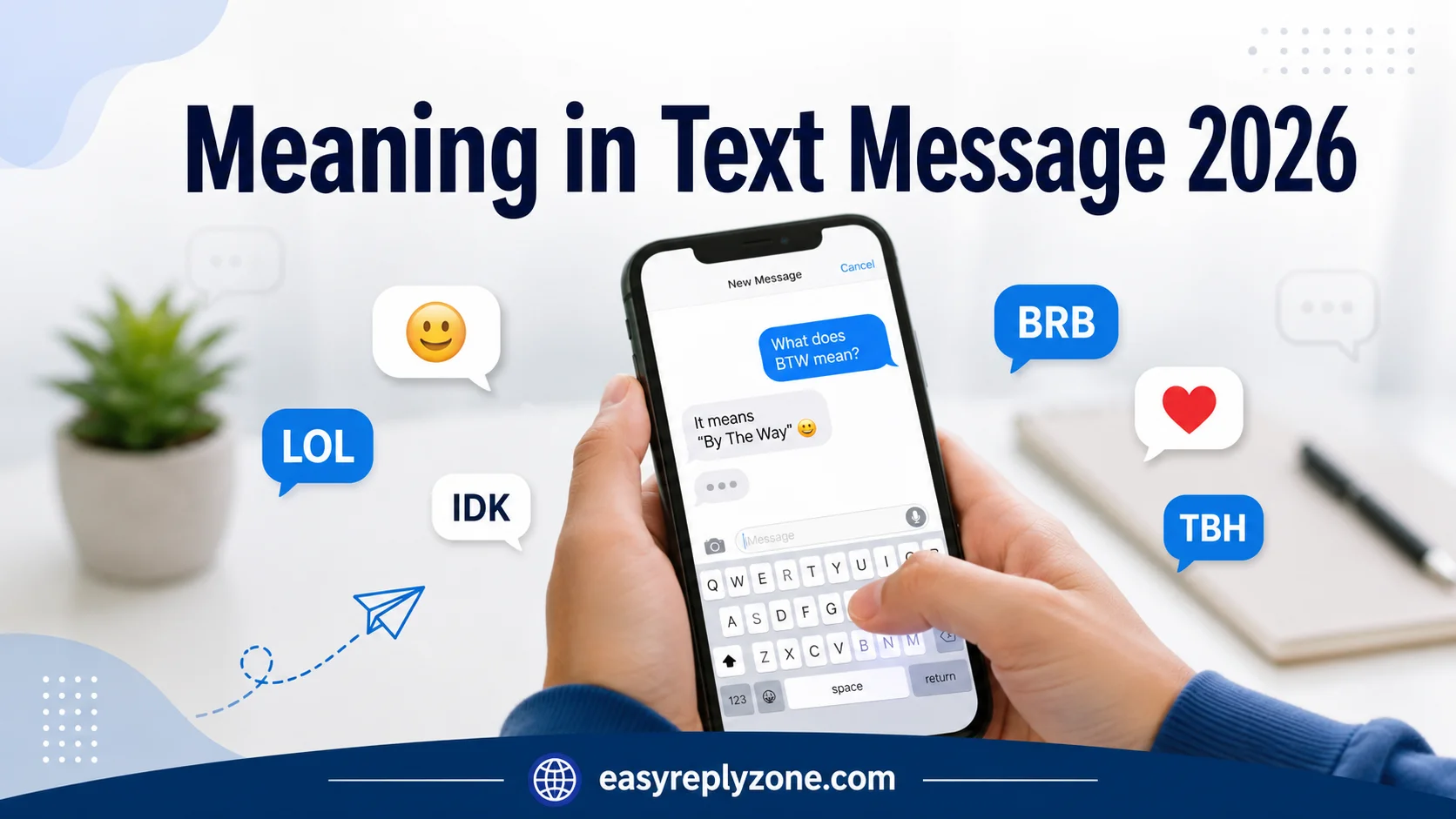

Meaning in Text Message 2026 helps you understand the latest texting terms, abbreviations, slang, and expressions people use in everyday digital conversations, chats, and social media today.
Text messages often include short forms, emojis, internet slang, and casual expressions that can be confusing, especially when their meanings change over time. Understanding these common texting terms helps you communicate clearly and avoid misunderstandings in personal, professional, and online conversations.
In this guide, you’ll discover the meaning of popular text message words and phrases, along with simple explanations and practical examples. Whether you’re learning modern texting language, checking an unfamiliar abbreviation, or improving your digital communication, this resource makes every term easy to understand and use correctly.
Quick Answer:
“Meaning in text message” generally refers to the meaning or interpretation of a word, phrase, abbreviation, emoji, or message when someone uses it while texting. It isn’t usually a slang abbreviation itself. Instead, people use the phrase when they want to understand what something means in a text conversation.
For example, someone might ask, “What does LOL mean in a text message?” Another person might ask, “What does ‘K’ mean in text?” Both questions focus on interpreting language within digital communication.
The key point is context. The same message can have different meanings depending on the relationship, previous conversation, punctuation, emoji use, and the sender’s normal texting style.
A text message tells you what someone wrote. Context helps you understand what they may have meant.
What Does “Meaning in Text Message” Really Mean?
The phrase meaning in text message usually describes an attempt to understand something used during digital communication.
It can refer to several things:
- The definition of a texting abbreviation
- The meaning of internet slang
- The interpretation of an emoji
- The tone behind a short reply
- The intention behind a particular phrase
- The emotional meaning attached to punctuation
- The difference between literal and implied meaning
For instance, “IDK” has a commonly recognized meaning: “I don’t know.” However, understanding why someone wrote it requires more context.
Consider these two messages:
- “IDK 😂 I haven’t decided yet.”
- “IDK. Do whatever you want.”
The abbreviation means the same basic thing in both examples. However, the second message may feel more frustrated or dismissive because of the surrounding words and punctuation.
That’s why understanding a text message meaning requires more than looking up individual words.
Meaning in Text vs. Meaning in a Text Message
These expressions overlap, but they aren’t always used in exactly the same way.
“Meaning in text” can refer broadly to the meaning of something within written communication. “Meaning in a text message” is more specific because it points to SMS, messaging apps, social media DMs, or other informal digital conversations.
For example:
| Phrase | What it usually refers to |
| Meaning in text | Meaning within written communication |
| Meaning in a text | Meaning within a particular written message |
| Meaning in text message | Meaning of language used while messaging |
| Text message meaning | The interpretation of a message or expression |
| What does this mean in text? | A request for clarification |
In everyday conversation, people often use these phrases interchangeably.
Why Context Matters When Understanding Text Message Meaning
Context is one of the most important parts of interpreting a message.
A dictionary can tell you what a word means. It can’t always tell you what that person intended when they used it.
Imagine receiving this message:
“Sure.”
It could mean genuine agreement. It could also indicate hesitation, frustration, or simple acknowledgment.
Now compare it with:
“Sure! That sounds great 😊”
The second message gives you much more information. The exclamation mark, additional sentence, and emoji all contribute to a warmer impression.
When you’re trying to understand the meaning in text message, consider these factors:
- Who sent it?
- What were you discussing?
- What is your relationship with that person?
- What did they say immediately before it?
- Do they normally use short messages?
- Did they include punctuation or emojis?
- Is the conversation serious, casual, romantic, or professional?
One message rarely provides enough evidence to determine someone’s exact intention.
What Can “Meaning in Text” Refer To?
The phrase can cover several types of digital language.
Words and Texting Slang
Some ordinary words develop informal meanings in online communities. Texting also encourages shorter and more expressive language.
For example, someone might describe something as “wild,” “sus,” “awkward,” or “random” in a way that differs slightly from a traditional dictionary definition.
The surrounding conversation determines how the expression works.
Texting Abbreviations
Abbreviations save time and space. Some have become so common that many people recognize them immediately.
| Abbreviation | Common meaning |
| LOL | Laughing out loud |
| BRB | Be right back |
| IDK | I don’t know |
| TBH | To be honest |
| IMO | In my opinion |
| FYI | For your information |
| SMH | Shaking my head |
| BTW | By the way |
| ASAP | As soon as possible |
| IRL | In real life |
These definitions are common, but context still matters. Some abbreviations can have multiple meanings in specialized communities.
Emojis and Symbols
An emoji can add emotional information that plain text doesn’t provide.
Compare:
“That’s great.”
with:
“That’s great! 😄”
The second version usually feels more enthusiastic.
However, emojis aren’t universal emotional codes. Their interpretation can depend on age, culture, relationship, platform, and personal habits.
Punctuation and Formatting
Punctuation can influence how a message feels.
Compare:
- Okay
- Okay!
- Okay.
- Okay…
- okayyy
The words remain closely related, yet the messages can create different impressions.
That doesn’t mean punctuation has a fixed emotional dictionary. Someone who always writes complete sentences may use periods without intending to sound angry.
How Tone Works in Text Messages
Tone becomes tricky because texting removes many of the signals people naturally use while speaking.
When someone says “Really?” in person, you can hear whether they’re surprised, excited, annoyed, or joking.
In a text, you only see the words.
That creates room for interpretation.
Common text-message tones include:
- Friendly
- Casual
- Excited
- Playful
- Sarcastic
- Flirty
- Concerned
- Annoyed
- Formal
- Dismissive
A useful rule is to separate what the message definitely says from what it might imply.
For example:
“Okay.”
Definite information: the person acknowledged something.
Possible interpretations: agreement, acceptance, impatience, or simple acknowledgment.
You shouldn’t automatically turn a possible interpretation into a fact.
How Punctuation Changes Meaning in Text Messages
Punctuation can affect the perceived tone of a message, especially in short conversations.
| Text | Possible impression |
| Okay | Neutral or casual |
| Okay! | Positive or enthusiastic |
| Okay. | Firm or straightforward |
| Okay… | Hesitant or uncertain |
| OK? | Asking for confirmation |
| Okayyy | Playful, teasing, or expressive |
These are possible impressions, not universal rules.
For example, someone who learned to type formally may naturally use periods in every message. Their “Thanks.” might simply mean “Thank you.”
Meanwhile, another person might write “THANK YOU!!!” whenever they’re excited.
Your interpretation should account for the sender’s usual habits.
How Emojis Change the Meaning of Text Messages
Emojis can act like small emotional cues.
They may:
- Make a statement sound friendlier.
- Show excitement.
- Signal humor.
- Soften criticism.
- Express affection.
- Add sarcasm or playfulness.
- Clarify an emotional reaction.
Consider the phrase:
“Sure”
Now add different emojis:
- Sure 🙂
- Sure 😂
- Sure ❤️
- Sure 🙃
Each version can create a different impression.
The heart emoji may suggest affection in one relationship. Between close friends, it could simply express warmth. The upside-down face may suggest irony, awkwardness, or playful frustration.
Therefore, emoji meaning in text messages depends heavily on context.
Common Text Message Examples and Their Possible Meanings
Some short messages create more confusion than longer ones because they provide very little context.
What Does “K” Mean in Text?
“K” commonly means “Okay.”
However, its tone can vary.
Someone may use “K” because they’re busy and want to acknowledge your message quickly. Another person might use it after an argument and intend to sound distant.
Compare:
“K, I’ll see you at 7.”
with:
“K.”
The first gives more context. The second leaves more room for interpretation.
Don’t assume that “K” always means someone is angry.
What Does “Okay” Mean in Text?
“Okay” can indicate:
- Agreement
- Acknowledgment
- Acceptance
- Understanding
- Neutral response
Tone depends on context.
“Okay! I’ll be there.” sounds enthusiastic.
“Okay, I understand.” sounds straightforward.
“Okay.” may sound more formal or firm in some conversations.
What Does “Fine” Mean in Text?
“Fine” can mean that something is acceptable.
However, people sometimes use it during disagreement to signal reluctant acceptance.
For example:
“Fine, let’s go tomorrow.”
The word itself doesn’t prove frustration. The preceding conversation might provide that clue.
Also Read This: NGL Meaning in Text: Examples & Guide
What Does “LOL” Mean in Text?
LOL traditionally means “laughing out loud.”
In modern casual messaging, people also use it as a conversational softener.
For example:
“I forgot my keys again lol.”
The sender may not literally be laughing. They could simply be making the sentence feel lighter.
That’s an important part of modern texting language.
What Does “Sure” Mean in Text?
“Sure” generally communicates agreement or willingness.
Still, context matters.
“Sure! I’d love to.” clearly sounds enthusiastic.
“Sure.” can sound neutral.
“Sure…” may suggest hesitation or reluctance.
Again, these are interpretations rather than guaranteed intentions.
Meaning in Text Messages From Friends
Friends often use shorter and less formal messages because they already share background knowledge.
A friend might send:
“Coming?”
Without further explanation, you may understand that they mean, “Are you coming?”
Close relationships allow people to remove words without losing much meaning.
Friends also tend to use:
- Inside jokes
- Nicknames
- Memes
- Abbreviations
- Reaction emojis
- Informal grammar
- Playful sarcasm
Because of that familiarity, a message that looks blunt to an outsider might feel completely normal between two friends.
Case Study: A Short Reply From a Friend
Suppose a friend normally sends long messages but suddenly replies:
“K.”
It’s reasonable to notice the change.
However, that still doesn’t prove they’re upset. They might be driving, working, tired, or distracted.
A better approach is to consider the broader pattern before deciding what the text message meaning is.
Meaning in Text Messages in Romantic Conversations
Romantic conversations add another layer because ordinary phrases can carry emotional implications.
Consider:
“Hey you 😊”
It could be friendly. It could also feel playful or flirtatious depending on the relationship.
Other examples include:
- “Miss you ❤️”
- “What are you doing?”
- “Goodnight 😊”
- “You’re cute.”
- “Wish you were here.”
These messages may suggest affection, but one sentence doesn’t establish someone’s complete intentions.
Example
Imagine someone texts:
“What are you doing tonight? 👀”
The eyes emoji may create a playful or suggestive tone. Yet the real meaning depends on the relationship and previous conversation.
When interpreting romantic texts, look for patterns rather than isolated clues.
Meaning in Text Messages at Work
Professional texting requires more caution.
A workplace message such as:
“Can you call me?”
could mean anything from a routine question to an urgent matter.
Likewise:
“Please handle this.”
sounds direct. It doesn’t necessarily mean the sender is angry.
Professional messages benefit from clear language because coworkers don’t always share the same communication habits.
Better workplace practices include:
- State the purpose clearly.
- Avoid unnecessary slang.
- Use specific deadlines.
- Ask questions when instructions are unclear.
- Don’t rely heavily on sarcasm.
- Confirm important information.
If a workplace text seems ambiguous, a simple response works well:
“Sure. Just to confirm, would you like this completed today?”
That’s clearer than guessing.
Meaning in Text Messages on Social Media
Texting language now appears across many platforms, including:
- Facebook Messenger
- Snapchat
- TikTok
- iMessage
- SMS
- Other messaging services
Different online communities develop their own habits.
A person may write differently in an Instagram DM than in a workplace message. Someone might use slang freely with friends but avoid it completely when communicating with a manager.
The platform matters, but the people involved matter more.
How to Figure Out What a Text Message Means
When a message confuses you, use a simple process.
Read the Entire Conversation
Don’t focus on one sentence.
The previous messages may explain why the person responded in a particular way.
Identify the Literal Meaning
Start with the obvious definition.
If someone says “I’m tired,” don’t immediately search for hidden meanings.
They may simply be tired.
Look for Slang or Abbreviations
If you don’t recognize a term, identify whether it’s an abbreviation, acronym, slang expression, or typo.
Check Emojis and Punctuation
These can provide useful clues about tone.
Still, don’t treat them as absolute proof.
Consider Your Relationship
A message from your best friend may mean something completely different from the same message sent by your manager.
Compare the Sender’s Normal Style
This is one of the most overlooked clues.
If someone always sends one-word responses, a one-word response probably isn’t unusual for them.
If they normally write enthusiastically and suddenly become extremely brief, the change may deserve attention.
Ask for Clarification
When the meaning remains unclear, asking is often better than guessing.
Try:
“What do you mean by that?”
or:
“Just to make sure I understood you correctly, what did you mean?”
Clear communication beats unnecessary overthinking.
Common Mistakes When Interpreting Text Messages
Text messages can create misunderstandings surprisingly quickly.
Taking Short Replies Personally
A short response doesn’t automatically mean someone is annoyed.
They may simply be busy.
Assuming Punctuation Has One Fixed Meaning
A period doesn’t always mean anger. An exclamation mark doesn’t always mean excitement.
Treating Slang Definitions as Universal
Online expressions can change between communities.
Ignoring Conversation History
The previous five messages may explain a confusing sixth message.
Overanalyzing a Single Emoji
An emoji can provide context, but it rarely tells the whole story.
Assuming Delayed Replies Reveal Feelings
Response time can depend on work, sleep, notifications, travel, or dozens of other factors.
Confusing Possibility With Certainty
This is perhaps the biggest mistake.
A message could sound cold without actually being intended as cold.
How to Ask “What Does This Mean in Text?” Naturally
If someone sends a phrase you don’t understand, you don’t need to pretend that you understand it.
Here are natural ways to ask:
- “What does that mean?”
- “What does that mean in this context?”
- “What do you mean by that?”
- “Sorry, I’m not familiar with that abbreviation. What does it mean?”
- “Do you mean that seriously or are you joking?”
The best option depends on the relationship.
With a friend, “What does that mean?” sounds natural.
At work, “Could you clarify what you mean?” sounds more professional.
Is “Meaning in Text Message” Correct English?
“Meaning in text message” is understandable, but it sounds more like a search phrase than natural conversational English.
In everyday speech, people are more likely to say:
- “What does this mean in a text?”
- “What does this mean in text messages?”
- “What does this mean when someone texts it?”
- “What does this text mean?”
Search engines often receive shortened phrases because users want quick answers. That doesn’t mean the exact search wording represents the most natural sentence in conversation.
Real Text Message Meaning Examples
The following table shows why context matters:
| Message | Possible meaning | Important context |
| K | Okay or acknowledgment | Sender’s normal style |
| Sure! | Enthusiastic agreement | Conversation topic |
| Sure. | Agreement or neutral response | Previous messages |
| Fine. | Acceptance or possible frustration | Argument or discussion |
| LOL | Amusement or conversational softening | What was said before |
| You’re funny 😂 | Genuine amusement | Relationship |
| Okay… | Hesitation or uncertainty | Situation |
| Thanks! | Appreciation | Overall tone |
| What? | Confusion, surprise, or frustration | Previous message |
| Really? | Surprise, doubt, or curiosity | Conversation context |
The word “possible” matters here.
Text interpretation involves clues. It doesn’t provide a perfect window into another person’s thoughts.
Quick Guide to Understanding Any Text Message
When you’re unsure about a message, remember this checklist:
- Read the whole conversation.
- Start with the literal meaning.
- Look up unfamiliar abbreviations.
- Consider emojis and punctuation.
- Think about your relationship with the sender.
- Compare the message with their normal style.
- Consider the situation.
- Avoid assuming negative intent.
- Ask for clarification if necessary.
This approach works for casual texts, social media messages, romantic conversations, and workplace communication.
FAQs:
What does “meaning in text message” refer to?
“Meaning in text message” refers to the definition or interpretation of a word, abbreviation, slang term, emoji, or phrase used in texting. The meaning can depend on the conversation, tone, and context.
Why do people use abbreviations in text messages?
People use text abbreviations to save time, type faster, and make conversations more casual. Common examples include LOL, BTW, FYI, IDK, and OMG, which are widely understood in digital communication.
Do texting meanings change over time?
Yes, texting language constantly evolves as new slang, abbreviations, memes, and online trends become popular. A term that has one meaning today may develop a different meaning depending on how people use it in modern conversations.
How can I understand an unfamiliar text abbreviation?
Look at the context of the conversation first, because the same abbreviation can sometimes have different meanings. You can also check a reliable slang or texting dictionary to confirm the intended definition.
Are text message abbreviations appropriate for everyone?
Not always. Casual abbreviations are usually suitable for friends, family, and informal chats, but professional messages should generally use clear and complete language unless the abbreviation is commonly accepted in that workplace.
What are some common texting terms in 2026?
Popular texting language includes abbreviations such as LOL, BRB, BTW, IDK, TBH, IMO, FYI, and TTYL. New slang and expressions can also become popular through social media, gaming communities, and online culture.
Can emojis change the meaning of a text message?
Yes, emojis can affect tone and meaning significantly. A simple sentence may sound friendly, sarcastic, playful, or emotional depending on the emoji used with it, so context is important when interpreting messages.
Is texting slang the same as internet slang?
They overlap, but they are not exactly the same. Texting slang is commonly used in messages and chats, while internet slang can appear across social media, forums, gaming platforms, comments, and other online communities.
Should I use slang in professional text messages?
It is better to use professional and straightforward language when communicating with coworkers, clients, managers, or business contacts. Casual slang may sometimes sound unclear or overly informal in a professional setting.
Why is understanding modern texting language important?
Understanding modern texting language makes digital conversations easier to follow and helps prevent misunderstandings. It also allows you to recognize common abbreviations, slang, emojis, and expressions used in everyday online communication.
Conclusion:
Understanding Meaning in Text Message 2026 can make modern digital communication much easier and clearer. Learning common texting abbreviations, slang, emojis, and expressions helps you understand conversations more confidently. Always consider the context and tone before interpreting an unfamiliar word or phrase.
For professional communication, choose clear and appropriate language to avoid confusion and misunderstandings.