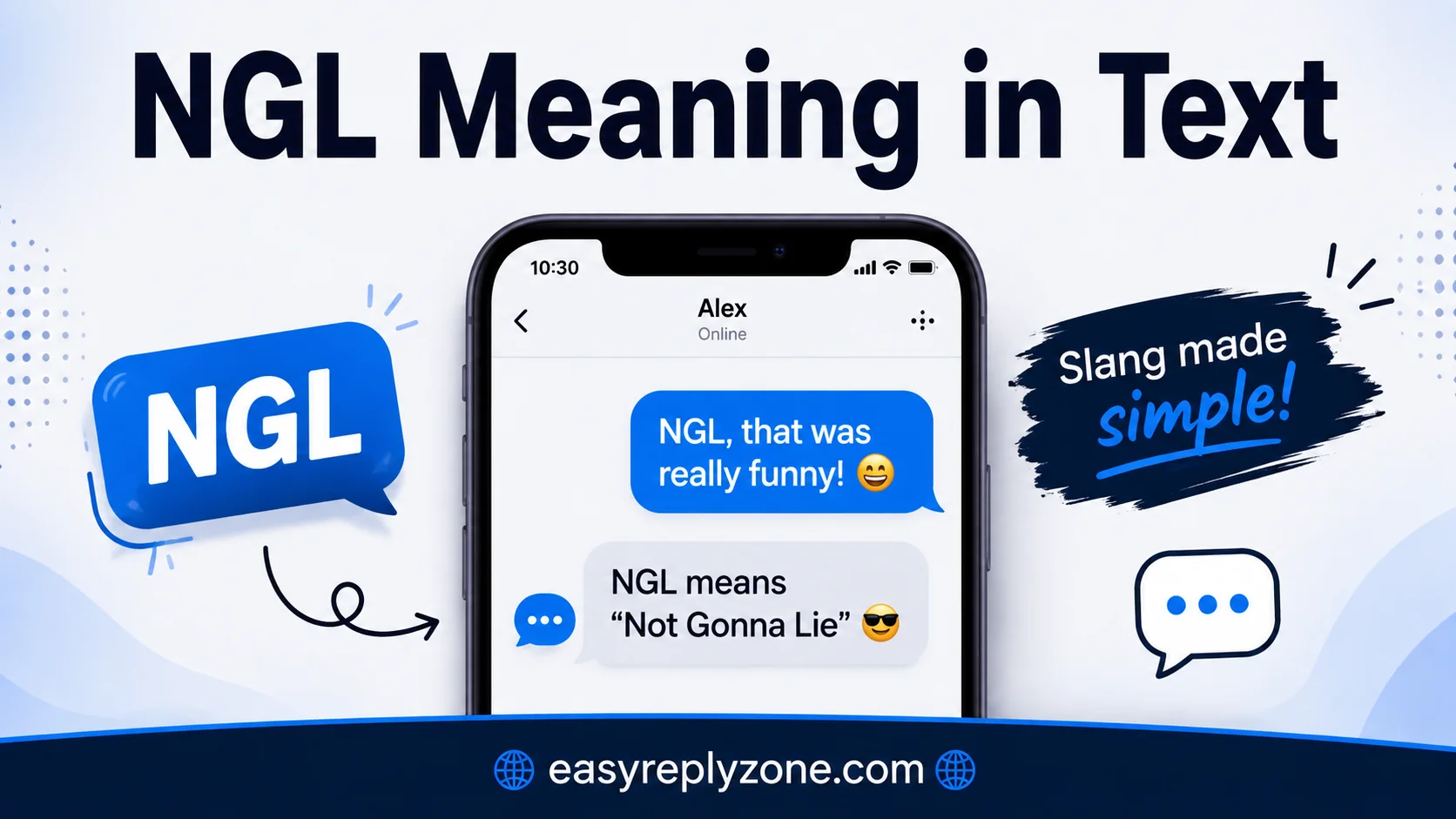

NGL Meaning in Text is a common question for people who see this abbreviation in text messages, chats, social media, and online conversations. It usually means “Not Gonna Lie.”
People use NGL to share an honest opinion, personal feeling, or straightforward response without sounding too formal. You may see it before a compliment, opinion, joke, or confession. Understanding its meaning and usage can help you communicate naturally in everyday digital conversations.
The abbreviation NGL is popular because it makes messages short, casual, and expressive. Its meaning can depend slightly on the context, but it generally introduces something the sender wants to say honestly. Learning common examples can help you understand internet slang, texting language, and modern online communication more easily.
Quick Answer:
NGL means “Not Gonna Lie” in text messages, chats, comments, and social media. People use it when they want to introduce something honest, candid, surprising, or personal.
For example:
- “NGL, that movie was amazing.” → “Not gonna lie, that movie was amazing.”
- “NGL, I’m pretty nervous.” → “Not gonna lie, I’m pretty nervous.”
- “That was actually funny, NGL.” → “That was actually funny, not gonna lie.”
NGL is informal internet slang, so it works best in texting and casual online conversations rather than academic or professional writing.
What Does NGL Mean in Text?
The most common NGL meaning in text is “Not Gonna Lie.” It acts as a casual way to signal that what follows is meant to sound honest or straightforward.
Someone might write:
“NGL, I didn’t expect you to win.”
The person isn’t necessarily suggesting that they normally lie. Instead, “NGL” adds emphasis to the honesty of the statement.
The abbreviation can introduce positive comments, negative opinions, admissions, jokes, or emotional reactions. That’s why you shouldn’t assume NGL always signals something good.
For instance:
- “NGL, you look great today.” — A compliment.
- “NGL, I didn’t like the ending.” — A criticism.
- “NGL, I was scared.” — An admission.
- “NGL, that was hilarious.” — A reaction.
- “NGL, I forgot about the appointment.” — A confession.
What Is the NGL Full Form?
The NGL full form is “Not Gonna Lie.”
Here, “gonna” is the informal spoken form of “going to.” The complete phrase is therefore essentially an informal expression meaning that someone is about to give a candid statement.
You may see the abbreviation in several forms:
| Form | Meaning | Common setting |
| NGL | Not Gonna Lie | Texting and social media |
| ngl | Not Gonna Lie | Casual chats |
| Ngl | Not Gonna Lie | Informal messages |
| not gonna lie | Full phrase | Texts and conversations |
| I’m ngl | I’m not gonna lie | Casual conversation |
There isn’t a meaningful difference between NGL and ngl. Capitalization usually depends on the person’s typing habits.
Someone might type:
“NGL, this is better than I expected.”
Another person could write:
“ngl this is better than i expected”
The intended meaning remains the same.
What Does NGL Mean in Slang?
As slang, NGL is a conversational shortcut for expressing sincerity or candidness. It can make a statement feel more spontaneous.
Think of it as a verbal signpost. It tells the reader, “Here’s my honest take.”
However, NGL doesn’t guarantee that a statement is objectively true. It simply frames the following words as the speaker’s honest perspective.
For example:
“NGL, this restaurant is overrated.”
That’s an opinion. NGL emphasizes that the person genuinely feels that way.
This distinction matters because internet slang often communicates tone as much as literal meaning.
Common Reasons People Use NGL
People commonly use NGL to:
- Give an honest opinion
- Admit something
- Share a personal feeling
- Introduce a compliment
- Express disappointment
- Make a surprising observation
- Add emphasis to a reaction
- Make criticism sound conversational
- Start an informal confession
- Agree with someone strongly
The phrase has a flexible role in digital communication. That’s one reason it appears so often in short-form conversations.
How Is NGL Used in Text Messages?
The position of NGL can change slightly depending on how someone writes the message.
NGL at the Beginning of a Sentence
This is probably the most recognizable format.
Examples:
- “NGL, I really enjoyed that.”
- “NGL, you were right.”
- “NGL, I’m exhausted.”
- “NGL, this looks incredible.”
Putting NGL at the beginning creates a small pause before the main thought.
NGL at the End of a Sentence
People also place the abbreviation at the end.
Examples:
- “That was pretty good, ngl.”
- “I actually enjoyed it, ngl.”
- “You handled that well, ngl.”
This style often feels even more casual because the speaker gives the opinion first and adds the honesty marker afterward.
NGL in the Middle of a Sentence
Although less common, NGL can appear naturally within a longer informal sentence.
Example:
“I was, ngl, pretty nervous before the interview.”
This style resembles spoken conversation where someone briefly interrupts a sentence to emphasize their honesty.
NGL as a Standalone Message
Someone might simply send:
“NGL…”
The meaning then depends heavily on what came before it.
For example:
Person A: “Did you actually like the new song?”
Person B: “NGL…”
Here, the sender may be preparing to give an honest opinion. The unfinished message creates anticipation rather than providing a complete meaning by itself.
What Does NGL Mean on Social Media?
The NGL meaning on social media usually remains “Not Gonna Lie.” Users commonly add it to comments, captions, replies, direct messages, and short posts.
It’s especially useful when someone wants to give a quick personal reaction.
NGL on Instagram
You might see:
- “NGL, this picture is amazing.”
- “NGL, I want this outfit.”
- “NGL, that was one of your best posts.”
On Instagram, context matters because NGL can also refer to the NGL app.
NGL on TikTok
TikTok users may use NGL when reacting to videos:
“NGL, this trend is actually fun.”
Or:
“NGL, I watched this five times.”
The abbreviation works well with TikTok’s fast, conversational comment style.
NGL on Snapchat
A Snapchat message might say:
“NGL, I thought you were joking.”
Here, the meaning is simply “Not Gonna Lie.”
NGL on WhatsApp and Messenger
In private chats, NGL usually has the same meaning:
“NGL, I forgot to text you back.”
It can also appear in group conversations when someone wants to share a candid opinion.
NGL on Reddit and Discord
Users may write:
“NGL, I think the original version was better.”
The abbreviation fits Reddit and Discord because both platforms rely heavily on informal online conversation.
Common Ways People Use NGL
Understanding the purpose behind the abbreviation makes it easier to interpret.
NGL for an Honest Opinion
Someone might write:
“NGL, I prefer the first design.”
The person is signaling that this is their genuine preference.
NGL for an Admission
It can introduce something embarrassing or personal:
“NGL, I completely forgot about the deadline.”
Here, the abbreviation softens the confession by making it sound conversational.
NGL for a Compliment
NGL frequently introduces positive statements:
“NGL, you look amazing in that outfit.”
The phrase can make a compliment sound spontaneous rather than rehearsed.
NGL for Criticism
It can also introduce a negative opinion:
“NGL, the ending wasn’t very good.”
Notice that NGL doesn’t automatically make criticism polite. The words that follow still determine how harsh the message sounds.
NGL for an Emotional Reaction
People use it when discussing feelings:
“NGL, I was really happy to see you.”
This gives the sentence a more personal and candid tone.
NGL for Humor
It can make an ordinary joke or observation feel more conversational:
“NGL, my dog has better social skills than I do.”
The humor comes from the statement itself. NGL simply frames it as an honest observation.
NGL Examples in Real Text Conversations
Context often explains slang better than a dictionary definition. Here are several realistic examples.
Between Friends
Friend 1: “Did you enjoy the party?”
Friend 2: “NGL, it was way more fun than I expected.”
The sender uses NGL before an honest reaction.
Talking About a Movie
Friend 1: “Have you seen the new movie?”
Friend 2: “Yeah. NGL, the first half was slow, but the ending was great.”
Here, NGL introduces a balanced opinion.
Giving a Compliment
Person 1: “I’m not sure about this outfit.”
Person 2: “NGL, it looks really good on you.”
The abbreviation makes the compliment sound casual and direct.
Admitting a Mistake
Person 1: “Did you send the email?”
Person 2: “NGL, I completely forgot.”
In this case, NGL introduces an admission.
Talking About Feelings
Person 1: “Were you nervous before the presentation?”
Person 2: “NGL, a little.”
The short response still communicates an honest feeling.
Also Read This: What Does “Home” Mean in Text
Does NGL Sound Rude, Friendly, or Honest?
NGL itself isn’t rude or friendly. Its tone depends on the statement around it.
Compare these examples:
| Message | Likely tone |
| “NGL, you did an amazing job.” | Positive |
| “NGL, I really enjoyed that.” | Friendly |
| “NGL, I don’t agree.” | Direct |
| “NGL, that wasn’t very good.” | Critical |
| “NGL, I’m nervous.” | Vulnerable |
| “NGL, that was hilarious.” | Playful |
This is important when interpreting a message from someone else.
If a friend says:
“NGL, I miss talking to you.”
the abbreviation doesn’t carry the emotional meaning by itself. The phrase “I miss talking to you” does. NGL simply introduces that thought as a candid statement.
NGL vs. TBH: What’s the Difference?
NGL and TBH overlap significantly, but they aren’t always used in exactly the same way.
TBH means “To Be Honest.” It can introduce an opinion or admission just like NGL.
| Abbreviation | Full form | Typical use | Tone |
| NGL | Not Gonna Lie | Candid reaction or admission | Casual |
| TBH | To Be Honest | Honest opinion or statement | Casual |
| FR | For Real | Agreement or emphasis | Informal |
| No cap | No lie / seriously | Emphasizing truthfulness | Slang |
Compare:
“NGL, this is difficult.”
and:
“TBH, this is difficult.”
Both communicate honesty. However, NGL often has a slightly more conversational or spontaneous feel in casual online writing.
The difference is subtle. In many everyday messages, people could use either one without changing the basic meaning.
When Should You Use NGL?
NGL works best when you’re having a casual conversation.
You can naturally use it in:
- Text messages
- Group chats
- Instagram comments
- TikTok comments
- Snapchat messages
- Discord conversations
- Reddit discussions
- Casual captions
- Friendly DMs
For example:
“NGL, I didn’t expect the concert to be that good.”
That’s a natural use because the setting is informal.
When Should You Avoid Using NGL?
Although NGL is common online, it doesn’t belong everywhere.
Avoid it in formal situations such as:
- Academic essays
- Job applications
- Professional reports
- Formal business emails
- Legal documents
- Official correspondence
- Research papers
- Formal presentations
Instead of:
“NGL, the results weren’t great.”
a professional version could say:
“The results were below expectations.”
The second version communicates the same general idea while fitting a formal environment.
NGL is useful slang, not formal English. Using the right register matters because language should match the situation.
What Does “I’m NGL” Mean?
“I’m NGL” is usually shorthand for “I’m not gonna lie.”
For example:
“I’m ngl, I was nervous.”
means:
“I’m not gonna lie, I was nervous.”
You’ll often see this construction in casual messages where someone wants to emphasize a personal reaction.
More examples include:
- “I’m ngl, I was surprised.”
- “I’m ngl, you were right.”
- “I’m ngl, that made me laugh.”
- “I’m ngl, I didn’t expect this.”
The phrase remains informal even when someone writes it with capital letters.
What Does NGL Mean From a Girl or Guy?
The NGL meaning doesn’t change based on who sends it. A girl, guy, friend, coworker, or stranger can use NGL to mean “Not Gonna Lie.”
What changes is the meaning of the complete message.
For example:
“NGL, you look great.”
could simply be a compliment.
Meanwhile:
“NGL, I miss you.”
expresses a more personal feeling.
The abbreviation itself doesn’t prove romantic interest, attraction, sarcasm, or any other specific intention. Context, wording, and the relationship between the people involved matter much more.
What Does NGL Mean in the NGL App?
Here’s where things can get confusing.
NGL is also the name of an anonymous messaging app. The app uses the same abbreviation associated with the phrase “Not Gonna Lie.”
According to the NGL app’s official website, the service is designed around receiving messages through shared NGL links. The platform became particularly associated with social-media sharing and anonymous messages.
So consider these two examples:
“NGL, that song is incredible.”
Here, NGL means “Not Gonna Lie.”
But:
“Send me something through my NGL link.”
Here, NGL likely refers to the app or service.
The surrounding words usually make the intended meaning obvious.
NGL Meaning vs. NGL App: How to Tell the Difference
| Example | Meaning |
| “NGL, I love this song.” | Not Gonna Lie |
| “NGL, that was awkward.” | Not Gonna Lie |
| “NGL, I wasn’t expecting that.” | Not Gonna Lie |
| “Check my NGL link.” | NGL app |
| “Send me a message on NGL.” | NGL app |
| “I posted an NGL link.” | NGL app |
A useful rule is simple:
If NGL appears as part of an opinion or reaction, it probably means “Not Gonna Lie.” If someone mentions a link, anonymous message, or profile, they’re probably talking about the app.
Common NGL Mistakes to Avoid
Knowing the definition is only half the story. You also need to understand how the abbreviation works in real communication.
Using NGL in Formal Writing
NGL belongs to informal digital language. Don’t drop it into an academic paper or professional report unless you’re specifically discussing internet slang.
Assuming NGL Always Introduces Something Positive
It doesn’t.
“NGL, I hated the ending.”
is just as valid as:
“NGL, I loved the ending.”
The abbreviation introduces honesty. It doesn’t determine whether the opinion is positive or negative.
Thinking NGL Means “I’m Telling You the Absolute Truth”
NGL signals that someone is presenting their statement as honest. It doesn’t turn a personal opinion into an objective fact.
For example:
“NGL, this is the best restaurant in town.”
That’s still a personal judgment.
Using NGL in Every Sentence
Overusing slang can make your messages feel repetitive.
Compare:
“NGL, NGL, I was NGL really tired, NGL.”
It sounds unnatural.
One well-placed abbreviation usually works better than several.
Confusing NGL Slang With the NGL App
Always examine the context. A sentence containing an opinion probably uses NGL as slang. A reference to a link or anonymous message likely points to the app.
NGL Sentence Examples at a Glance
Here’s a quick reference for common uses:
| Situation | Example |
| Honest opinion | “NGL, I prefer the first one.” |
| Compliment | “NGL, you look amazing.” |
| Admission | “NGL, I forgot.” |
| Surprise | “NGL, I didn’t expect that.” |
| Criticism | “NGL, that wasn’t my favorite.” |
| Excitement | “NGL, I’m really excited.” |
| Nervousness | “NGL, I was nervous.” |
| Humor | “NGL, that made me laugh.” |
| Agreement | “NGL, you’re absolutely right.” |
| Disappointment | “NGL, I expected more.” |
These examples show why context matters. NGL doesn’t carry one fixed emotional tone.
A Simple Way to Remember NGL Meaning
If you struggle to remember what NGL stands for, connect it with the phrase:
NGL = Not Gonna Lie = Here’s my honest take.
That simple association covers most everyday uses.
For example:
“NGL, I’m tired.”
Think:
“Not gonna lie, I’m tired.”
Or:
“That was amazing, ngl.”
Think:
“That was amazing, not gonna lie.”
Once you see the pattern, the abbreviation becomes easy to recognize.
FAQs:
What does NGL mean in text?
NGL means “Not Gonna Lie.” People use it in text messages and online chats when they want to express an honest opinion, feeling, or statement in a casual way.
What does NGL stand for?
NGL stands for “Not Gonna Lie.” It is a popular texting abbreviation used on social media, messaging apps, and informal online conversations.
Is NGL a slang word?
Yes, NGL is internet slang commonly used in casual conversations. It helps people express their thoughts quickly and naturally without writing the complete phrase “Not Gonna Lie.”
How is NGL used in a sentence?
You can use NGL before sharing an honest thought. For example, “NGL, this movie was really good” means “Not gonna lie, this movie was really good.”
Is NGL formal or informal?
NGL is informal and is mainly used in texting, social media, and friendly conversations. It is generally not appropriate for formal emails, business writing, or professional documents.
6. What is the difference between NGL and TBH?
Both NGL and TBH can introduce an honest opinion. NGL means “Not Gonna Lie,” while TBH means “To Be Honest.” Their meanings are very similar in casual texting.
Can NGL be used in a positive sentence?
Yes, NGL can introduce positive statements, compliments, or praise. For example, “NGL, you did an amazing job” shows that the speaker is being honest about their opinion.
Can NGL be used for negative opinions?
Yes, NGL can also introduce a negative or critical opinion, although the tone depends on the context. For example, “NGL, I didn’t really enjoy the movie” expresses an honest personal opinion.
Is NGL still used on social media?
Yes, NGL remains common in casual digital communication, especially in text messages, comments, captions, and social media conversations. Its short form makes it convenient for quick and informal communication.
What does NGL mean in a chat?
In a chat, NGL usually means “Not Gonna Lie.” It signals that the person is about to share something honestly or directly, such as an opinion, reaction, compliment, or personal feeling.
Conclusion:
NGL means “Not Gonna Lie” and is widely used in texting and online conversations. It usually introduces an honest opinion, feeling, or reaction in a casual way. Although NGL is useful in friendly chats and social media, it is better to avoid it in formal communication.
Understanding this abbreviation can make modern internet slang and texting language much easier to understand.