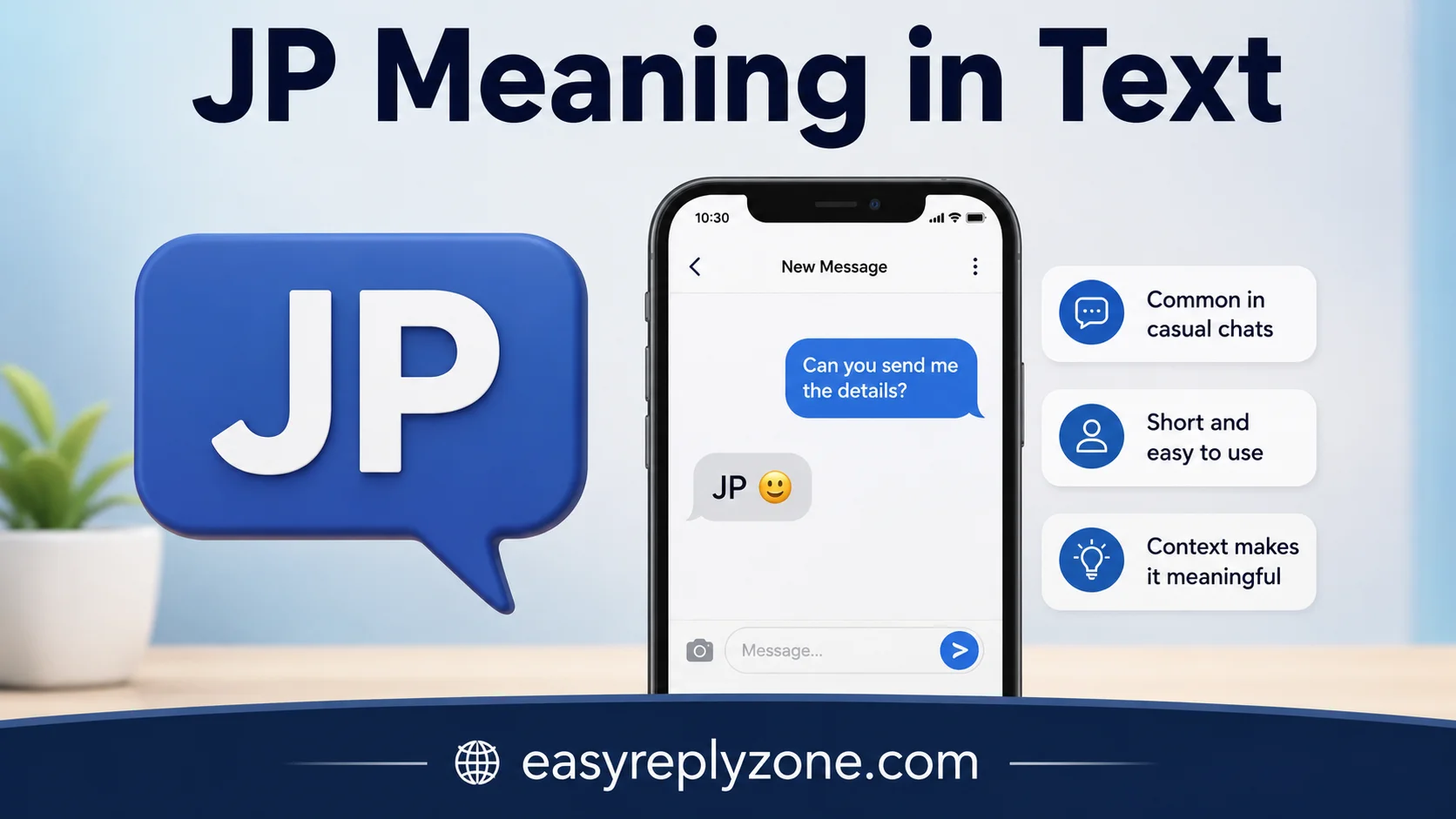

JP meaning in text can feel confusing when you see it in a message without any context. In casual chats, JP usually means “Just Playing,” signaling that someone is joking, teasing, or not being serious.
When someone adds JP after a funny or exaggerated statement, they usually want you to understand the playful tone. For example, “You’re officially banned from choosing dinner, JP 😂” means the person is joking, not genuinely angry. This short abbreviation helps make casual conversations feel lighter and prevents unnecessary misunderstandings.
However, JP doesn’t always mean “Just Playing.” In gaming, travel, or international conversations, it can refer to Japan or Japanese. It may also represent someone’s initials or another context-specific term. Therefore, checking the surrounding words and conversation topic is the best way to understand what JP actually means.
Quick Answer:
In casual text messages and online chats, JP usually means “Just Playing.”
It tells the other person that the previous statement wasn’t meant seriously. Someone might use it after a playful insult, sarcastic comment, exaggerated claim, or harmless tease.
For example:
“You’re the most annoying person ever. JP 😂”
Here, JP means “Just Playing.” The sender isn’t seriously calling the other person annoying. They’re signaling that the comment was playful.
A useful way to remember it is:
JP = Just Playing = “I’m joking, don’t take that seriously.”
The abbreviation isn’t always universal, though. If you see “JP server,” “JP player,” or another phrase connected to Japan, the intended meaning is probably different.
JP Meaning in Text: What Does “Just Playing” Mean?
When someone uses JP as “Just Playing,” they’re usually trying to change or clarify the tone of something they just said.
Imagine a friend texts:
“I’m never inviting you anywhere again. JP 😂”
Without the final abbreviation, the message could sound annoyed or serious. Adding JP tells you to read the sentence as playful banter.
This makes the abbreviation especially useful in text-based communication. Written messages don’t carry facial expressions, gestures, or vocal tone. A sarcastic sentence can therefore look completely serious on a screen.
JP acts as a small tone marker.
People may use it to:
- Show they’re joking
- Make teasing sound lighter
- Clarify sarcasm
- Prevent a playful comment from being misunderstood
- Signal that an exaggerated statement isn’t literal
- Keep a conversation relaxed
- Add humor without writing a full explanation
According to texting-reference sources, “Just Playing” is the primary casual-text interpretation of JP, although the abbreviation can have other meanings in different contexts.
JP Abbreviation Meaning at a Glance
| JP Meaning | Common Context | What It Usually Means |
| Just Playing | Casual texting and chats | “I’m joking” or “I’m teasing” |
| Japan / Japanese | Gaming, travel, international communities | A reference to Japan or Japanese content |
| Initials | Personal conversations | Someone’s first and last initials |
| Justice of the Peace | Legal or civil contexts | A formal legal title |
| Specialized abbreviation | Professional or community-specific discussions | Depends on the subject |
The important point is that these meanings don’t have equal weight in every conversation. If a friend writes “JP 😂” after teasing you, “Just Playing” makes sense. If a gaming community discusses a “JP server,” Japan is a much more natural interpretation.
Context is the deciding factor.
Why Do People Say JP After a Message?
The easiest answer is tone control.
Texting removes many of the signals people normally use to understand intent. When someone speaks face-to-face, you can hear whether they’re laughing or see a playful expression. Text doesn’t give you those clues automatically.
Consider these two messages:
“You’re terrible at choosing movies.”
“You’re terrible at choosing movies. JP 😂”
The first could be genuine criticism. The second clearly leans toward playful teasing.
That’s why JP can work like a verbal wink. It doesn’t completely rewrite the sentence, but it tells the reader how to interpret it.
People commonly add JP after:
- A playful insult
- A sarcastic statement
- A fake complaint
- An exaggerated reaction
- A teasing comment
- A deliberately dramatic statement
Example
“I’m blocking you for choosing pineapple pizza. JP 😂”
The sender isn’t actually announcing a serious relationship-ending decision. The exaggerated statement creates the joke while JP removes much of the ambiguity.
JP Meaning in Real Text Messages
Understanding JP meaning in texting becomes easier when you see how it works in natural conversations.
After a Joke
Person A: “You really thought that was a good idea?”
Person B: “Absolutely.”
Person A: “You’re hopeless. JP 😂”
Here, JP makes the insult playful rather than genuinely hostile.
After Teasing
“You take three hours to reply to one message. JP 😭”
The sender is exaggerating for humor.
After a Fake Threat
“I’m stealing your fries next time. JP.”
The statement sounds aggressive when read literally. The context and JP indicate playful behavior.
After an Exaggerated Reaction
“I’m never speaking to you again after that spoiler. JP 😂”
The dramatic wording is part of the joke.
As a Standalone Message
Sometimes someone may send:
“JP 😂”
In that situation, look at the previous message. The abbreviation usually refers to something that was just said or done.
JP Meaning on Social Media
The JP meaning on social media generally follows the same casual pattern as texting. People may use it in comments, direct messages, replies, and group conversations when they want to signal playful intent.
It doesn’t usually have a completely different definition simply because you’re using Instagram instead of a messaging app.
JP on Instagram
In an Instagram DM, someone might write:
“That might be the worst selfie I’ve ever seen. JP 😂”
The person is likely teasing rather than seriously criticizing the photo.
A similar pattern can appear in comments:
“You definitely can’t cook. JP 😭”
The surrounding conversation tells you whether the comment is affectionate teasing or an actual criticism.
JP on Snapchat
Snapchat conversations often move quickly, so short expressions can fit naturally into the flow.
For example:
“I’m deleting you after that 😂 JP”
The sender uses JP to make the playful nature clearer.
JP on TikTok
You may also encounter abbreviations in TikTok comments and replies. However, don’t assume that every “JP” comment means “Just Playing.” Look at the conversation around it.
If someone writes:
“JP server is wild”
the abbreviation probably isn’t functioning as a joke marker. The reference to a server makes a Japan-related interpretation more plausible.
JP Meaning in Gaming and Discord
Gaming is one area where context becomes especially important.
A gamer might use JP as a quick way to say “Just Playing” after a joke:
“I’m carrying this whole team. JP 😂”
But the same two letters can refer to Japan or Japanese in a gaming context.
For example:
“The JP server is getting the update tomorrow.”
Here, JP most naturally refers to Japan or a Japanese server, not “Just Playing.”
Likewise:
“He’s a JP player.”
The phrase may describe a Japanese player depending on the community and conversation.
This is why blindly expanding every JP abbreviation to “Just Playing” can lead to mistakes. Read the words surrounding it first.
A Simple Gaming Test
Ask:
Does JP describe the tone of the message?
If yes, Just Playing may fit.
Does JP describe a server, region, player, version, or location?
If yes, Japan/Japanese may be the better interpretation.
JP Meaning When Someone Is Flirting
Seeing JP in a romantic or dating conversation can be confusing because the surrounding message may feel flirtatious.
However, JP itself doesn’t mean flirting.
Instead, the abbreviation can appear inside a flirtatious conversation to show that a particular comment was playful.
For example:
“You’re becoming my favorite person. JP… maybe. 😏”
The flirting comes from the content and tone of the sentence. JP simply suggests that the speaker may be playing around or softening the statement.
Another example:
“I was going to ask you out. JP 😂”
Here, the abbreviation signals that the sender is backing away from the seriousness of the statement.
That doesn’t automatically mean they’re uninterested. Context, relationship, and the rest of the conversation matter far more than two letters.
JP Meaning Between Friends
Among friends, JP can fit naturally into playful banter.
Friends often exaggerate, roast each other, and make deliberately dramatic statements. Adding a short marker such as JP can help prevent the joke from sounding genuinely hostile.
For example:
“You’re officially banned from choosing the restaurant. JP 😂”
Or:
“I can’t believe I’m still friends with you. JP.”
Or:
“You owe me dinner after that. JP 😭”
The relationship matters here. A sentence that sounds funny between close friends could sound rude coming from a stranger.
That’s an important distinction: JP doesn’t automatically make a harsh statement harmless.
Also Read This: KMSL Meaning in Text: Full Form, Usage, Examples & Social Media Trends
How to Tell Which JP Meaning Someone Intended
When you’re unsure about what JP means in a text, don’t guess immediately. Use the surrounding information.
Look at the Previous Sentence
If the previous message sounds like a joke, Just Playing is a strong possibility.
“You’re so dramatic. JP 😂”
The phrase clearly works as a playful clarification.
Check the Conversation Topic
If you’re discussing:
- Japan
- Japanese culture
- Travel
- Gaming servers
- Anime
- International releases
then a Japan-related meaning becomes more plausible.
Look at the Words Around JP
Compare these:
“I was kidding, JP 😂”
This strongly suggests Just Playing.
Now compare:
“The JP server opens at 8.”
Here, Japan/Japanese makes much more sense.
Pay Attention to Emojis
Emojis can provide useful clues.
😂 😭 😜 😆 😏 may reinforce a playful reading.
Still, emojis aren’t proof. A person can use almost any emoji ironically, so the complete message remains more important.
Consider Who Sent It
If JP appears as part of a person’s name, it could simply be initials.
For example:
“JP will join us after work.”
In that sentence, “Just Playing” doesn’t make grammatical sense. The most sensible interpretation is probably a person’s initials or another context-specific reference.
JP vs. JK: What’s the Difference?
JP and JK can overlap, but they’re not exactly the same phrase.
| Abbreviation | Meaning | Typical Purpose |
| JP | Just Playing | Shows playful teasing or joking |
| JK | Just Kidding | Directly signals that something wasn’t serious |
For example:
“You’re paying for dinner. JP 😂”
and:
“You’re paying for dinner. JK 😂”
Both can communicate that the speaker isn’t serious.
The difference is mainly in the wording behind the abbreviation. JP emphasizes playing around, while JK explicitly means “Just Kidding.”
If you’re unsure what a particular person means by JP, don’t assume they intended JK. Read the surrounding conversation.
Is JP the Same as “Just Joking”?
In casual conversations, JP can serve a similar purpose to “just joking.” Several texting references describe it as a way to communicate that a statement was playful or not serious.
Still, “Just Playing” is the clearest primary expansion for the texting abbreviation.
You can think about the relationship this way:
- Just Playing → “I’m messing around.”
- Just Kidding → “I’m kidding.”
- Just Joking → “I wasn’t serious.”
- JP → A short informal way of signaling playful intent.
These expressions overlap in everyday conversation without being perfectly interchangeable in every situation.
Is JP Rude or Offensive?
On its own, JP isn’t normally rude or offensive when it means “Just Playing.”
The problem comes from what appears before it.
For example:
“You’re awful at everything. JP.”
Adding JP doesn’t automatically turn a genuinely hurtful statement into a harmless joke.
A better example would be:
“You somehow managed to burn toast again. JP 😂”
The second sentence has a clearer playful context.
When using JP, think about your relationship with the other person. A joke that works with a close friend may fall flat with a coworker, stranger, or someone you’re still getting to know.
JP Is Usually Fine When:
- You’re talking casually with friends.
- The conversation already has a playful tone.
- The joke is clearly harmless.
- Both people regularly tease each other.
Use More Caution When:
- The subject is sensitive.
- The other person seems upset.
- You’re discussing a serious problem.
- You’re communicating with someone professionally.
- The joke could be interpreted as an insult.
Can You Use JP in Professional Messages?
It’s better to be selective.
JP is informal internet shorthand, so it isn’t the best choice for formal emails, applications, official documents, or serious workplace communication.
Instead of:
“I guess you’re fired. JP 😂”
a professional environment calls for clearer language.
You could say:
“Just kidding—I was only teasing.”
Or:
“I was joking.”
Clear language reduces the chance of confusion, especially when the relationship isn’t casual.
Professional communication also benefits from avoiding abbreviations that the recipient may not recognize.
Common Mistakes When Interpreting JP
A few simple mistakes can completely change the meaning.
Assuming JP Always Means “Just Playing”
This is the biggest mistake.
JP can have multiple meanings, so context should always come first.
Ignoring the Words Around It
Don’t interpret two letters in isolation when the surrounding sentence provides the answer.
Assuming JP Means Flirting
JP isn’t inherently romantic. The surrounding message determines whether a conversation is flirtatious.
Treating JP and JK as Identical
They can perform similar functions, but their literal expansions differ.
Using JP After a Hurtful Comment
A joking label doesn’t erase the impact of a genuinely offensive statement.
Assuming the Platform Determines the Meaning
Instagram, Snapchat, TikTok, Discord, and ordinary text messages don’t necessarily give JP completely different slang definitions. The conversation itself is usually more informative than the app.
JP Meaning in Different Contexts
The following table makes the distinction easier to remember:
| Context | Likely Meaning | Example |
| Casual text | Just Playing | “Relax, JP 😂” |
| Friendly teasing | Just Playing | “You’re impossible. JP.” |
| Instagram DM | Just Playing | “Worst picture ever. JP 😭” |
| Snapchat | Just Playing | “I’m blocking you. JP 😂” |
| TikTok comment | Usually context-dependent | “I hated it. JP 😂” |
| Gaming joke | Just Playing | “I carried the whole team. JP.” |
| Gaming region | Japan/Japanese | “The JP server opens tomorrow.” |
| Personal conversation | Initials | “JP called earlier.” |
| Legal context | Justice of the Peace | “The document needs the JP’s signature.” |
The table highlights one important rule: meaning follows context.
How to Respond When Someone Says JP
If someone sends JP after a joke, you don’t need a complicated response.
Funny Responses
- “You had me for a second 😂”
- “Nice save!”
- “Too late. I believed you.”
- “That was almost believable.”
- “You can’t take it back now 😂”
Casual Responses
- “Haha, got it.”
- “I figured you were joking.”
- “No worries.”
- “I knew you were playing.”
Playful Responses
- “Good save, but I’m still judging you.”
- “I’ll pretend I believed you.”
- “That’s exactly what someone guilty would say 😂”
- “JP noted. Your reputation remains questionable.”
When You’re Confused
Simply ask:
“What do you mean by JP?”
There’s nothing awkward about asking. Context beats guessing, especially when an abbreviation can have several meanings.
A Real-World Interpretation Example
Imagine receiving this message:
“You’re officially banned from picking the restaurant again. JP 😂”
At first glance, “banned” sounds serious. But several clues change the interpretation:
- The statement is exaggerated.
- The conversation involves friends.
- The laughing emoji supports a humorous tone.
- JP appears immediately after the statement.
- There is no serious context suggesting an actual ban.
The most natural interpretation is therefore “Just Playing.”
Now consider:
“We’re joining the JP server tonight.”
The interpretation changes completely.
Here, server is a strong contextual clue. JP most likely refers to Japan or a Japanese server, not “Just Playing.”
This is why interpreting abbreviations requires more than memorizing a definition. You need to examine how the abbreviation functions inside the sentence.
FAQs:
What does JP mean in text?
JP usually means “Just Playing” in casual text messages. People use it after a joke, tease, sarcastic comment, or exaggerated statement to show that they aren’t being serious.
What does JP mean in texting from a girl?
If a girl uses JP after a playful or teasing message, it most likely means “Just Playing.” The abbreviation itself doesn’t indicate flirting, so the surrounding conversation and tone matter more.
What does JP mean on social media?
On social media, JP can mean “Just Playing” when used after a joke or playful comment. However, it may have other meanings depending on the conversation, platform, community, or topic.
Is JP the same as JK?
No, but they can have a similar purpose. JP means “Just Playing,” while JK means “Just Kidding.” Both abbreviations can tell someone that a previous statement wasn’t meant seriously.
What does JP mean on Snapchat?
On Snapchat, JP commonly means “Just Playing” when someone adds it after teasing or joking. For example, “I’m blocking you, JP 😂” usually means the person is only joking.
What does JP mean on Instagram?
The JP meaning on Instagram often refers to “Just Playing” in casual DMs, comments, or replies. However, you should always check the surrounding message before assuming its meaning.
What does JP mean in gaming?
In gaming, JP can mean “Just Playing” after a joke, but it can also refer to Japan or Japanese. For example, “JP server” most likely refers to a Japanese or Japan-based server.
Does JP mean flirting?
JP doesn’t directly mean flirting. Someone can use it during a romantic or playful conversation, but the flirting comes from the surrounding words, emojis, and overall tone rather than the abbreviation itself.
Can JP mean someone’s initials?
Yes. JP can represent someone’s initials when the conversation refers to a specific person. For example, “JP will call you later” probably refers to a person rather than “Just Playing.”
How should I respond when someone says JP?
You can respond casually with “Haha, got it,” “You had me for a second 😂,” or “Nice save!” If you’re unsure about the meaning, simply ask, “What do you mean by JP?”
Conclusion:
The most common JP meaning in text is “Just Playing,” especially when someone is teasing, joking, or exaggerating. However, context can change its meaning completely. In gaming and international conversations, JP may refer to Japan or Japanese, while personal chats can use it as initials. Always check the surrounding words and conversation tone before deciding what JP means.