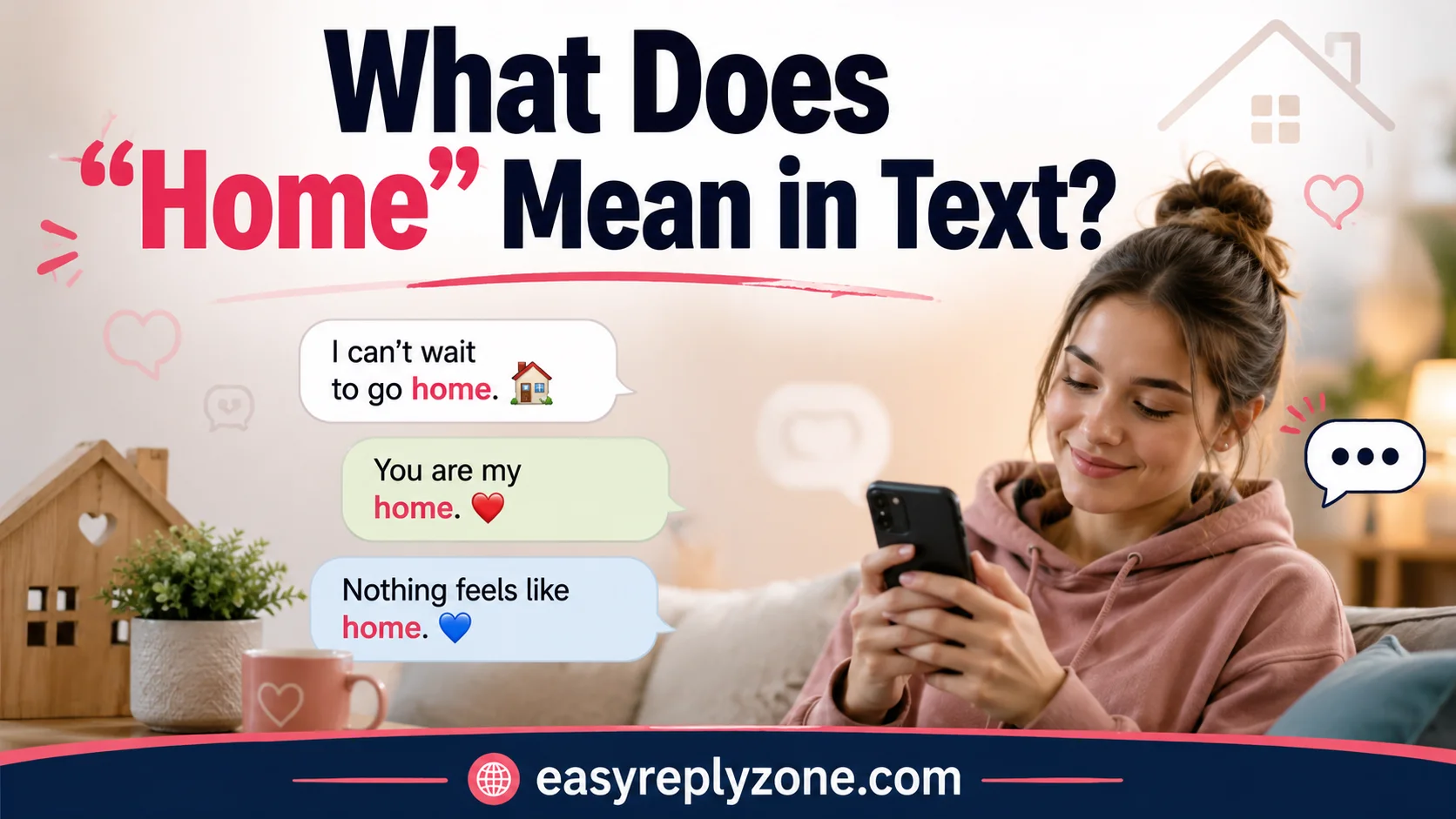

What Does “Home” Mean in Text usually refers to a place of comfort, safety, belonging, or familiarity. Its meaning can change depending on the conversation, relationship, and context.
In text messages, “home” can have a simple meaning, such as asking whether someone has arrived home or is currently there. However, it may also express emotional connection, comfort, closeness, or a sense of belonging. Understanding the context helps you interpret the message correctly and avoid confusion.
The word “home” can also carry different meanings in casual conversations, relationships, friendships, and social media chats. Someone might use it to describe a physical place or express that they feel safe, comfortable, and accepted with another person. This guide explains its common meanings, examples, and proper usage in everyday texting.
Quick Answer:
“Home” usually means the place where someone lives, stays, or considers their home. In texting, it can also refer to a place of comfort, familiarity, safety, origin, or emotional belonging.
For example:
- “I’m home.” → I have arrived at my house or usual residence.
- “Are you home?” → Are you currently at home?
- “Heading home.” → I’m traveling back to where I live.
- “This place feels like home.” → This place feels comfortable and familiar.
- “You feel like home.” → Being with you creates a strong sense of comfort, safety, or belonging.
- “I just want to go home.” → The person wants to return to their home or a place where they feel safe.
Importantly, “home” isn’t normally a texting acronym or abbreviation. It’s an ordinary English word that people use naturally in digital conversations. Its figurative meanings come from the broader use of the word rather than from a special texting code.
What Does “Home” Mean in Text Messages?
The most common meaning of home in text messages is simply someone’s residence. When a person says, “I’m home,” they normally mean they have returned to the place where they live.
However, English speakers also use home more broadly. It can describe a hometown, country, family environment, community, or even a person who provides a strong feeling of comfort.
This broader meaning explains why a short word can carry very different emotions.
| Text phrase | Likely meaning | Typical tone |
| “I’m home.” | The person has arrived at their residence. | Casual |
| “Are you home?” | Asking whether someone is at home. | Neutral |
| “Heading home.” | Returning to their residence. | Casual |
| “Home at last.” | Finally returning home. | Relieved |
| “Feels like home.” | Feels familiar and comfortable. | Emotional |
| “You feel like home.” | Someone creates comfort and belonging. | Affectionate |
| “Go home.” | Return to your home. | Neutral, blunt, or teasing |
| “Take me home.” | Wants to return home. | Context-dependent |
The key point is simple: the word itself doesn’t determine the entire message. Context does.
Is “Home” Slang or a Texting Acronym?
No. “Home” isn’t generally recognized as a standard texting acronym like LOL, BRB, or IDK.
People sometimes search for a hidden “full form” of HOME because internet slang websites list many unusual acronym expansions. Those expansions don’t mean that ordinary texters use HOME that way.
If someone writes:
“I’m finally home.”
There’s no reason to interpret HOME as an acronym. The person almost certainly means they have arrived at their residence.
Does HOME Have an Official Texting Full Form?
There is no universally accepted texting full form for HOME.
This distinction matters because online acronym lists can contain user-submitted definitions, organization names, technical terms, or creative backronyms. Those aren’t necessarily meanings used in everyday texting.
The safest approach is to interpret the word according to the actual conversation.
For example:
- “Are you home?” → residence
- “I miss home.” → hometown, family, or familiar place
- “You are my home.” → emotional belonging
- “Home sweet home.” → comfort and happiness about being home
The surrounding words tell you far more than capitalization does.
The Different Meanings of “Home” in Text
Although the basic meaning remains connected to living or belonging, home can take several meanings in digital conversations.
Home as Your House or Residence
This is the most straightforward use.
Someone might text:
“I’m home now.”
They usually mean they have arrived at the place where they live.
Other examples include:
- “Are you home?”
- “I’ll be home soon.”
- “Call me when you get home.”
- “I left my phone at home.”
- “I’m staying home tonight.”
In these examples, home refers to a physical place.
Home as a Place of Belonging
Home doesn’t always mean a specific building. Someone can consider an entire city, town, country, neighborhood, or community their home.
For example:
“New York will always feel like home.”
The speaker may not currently live there. Instead, the city represents their roots, memories, relationships, or identity.
This use becomes especially common when people talk about moving away, studying abroad, traveling, or returning to their hometown.
Home as Comfort or Safety
The word can also describe an emotional state.
Consider:
“This little café feels like home.”
The café isn’t literally the person’s residence. The phrase means that the environment feels familiar, welcoming, and comfortable.
That’s why home often appears in conversations about peace, security, trust, and belonging.
Home as a Person
One of the most emotional uses appears when people describe another person as home.
For example:
“You are my home.”
This usually isn’t literal. It suggests that being with that person creates a feeling of security, familiarity, acceptance, or emotional peace.
Depending on the relationship, the phrase can sound romantic. It can also describe an extremely close friendship or family bond.
Home as a Familiar Place
People sometimes call a workplace, school, sports club, restaurant, or community “home” when they have developed a strong connection with it.
For example:
“After ten years at this club, it feels like home.”
The speaker is describing belonging rather than housing.
What Does “I’m Home” Mean in Text?
“I’m home” usually means “I have arrived at home.”
It often appears after someone has been traveling, working, studying, or spending time somewhere else.
For example:
Person A: “Let me know when you get back.”
Person B: “I’m home.”
The second person is confirming that they have arrived safely.
However, the tone can change with additional words or emojis.
- “I’m home.” → Simple update.
- “Finally home!” → Relief or exhaustion.
- “I’m finally home 😮💨” → Tired but relieved.
- “Home ❤️” → May carry warmth or affection.
- “I’m home, what’s up?” → The person is now available to talk.
So when someone texts “I’m home,” don’t search for a hidden slang meaning. The normal interpretation is usually the correct one.
What Does “Are You Home?” Mean in Text?
“Are you home?” normally asks whether someone is currently at their residence.
Yet the reason for asking can vary.
Someone might ask because they:
- Want to call you.
- Want to visit you.
- Need to talk privately.
- Want to know whether you’ve arrived safely.
- Need you to check something at home.
- Are planning to meet you.
For example:
“Are you home? I need to tell you something.”
Here, the question may have little to do with the physical house itself. The sender may simply want to know whether you’re somewhere private enough to talk.
How Context Changes “Are You Home?”
Consider these examples:
“Are you home? I left my keys there.”
This is practical.
“Are you home yet?”
This may show concern or simply ask about someone’s arrival.
“Are you home? ❤️”
The emoji may add warmth, although it doesn’t automatically make the message romantic.
“Are you home? I’m outside.”
This is clearly about location.
Context turns the same three words into different conversational situations.
What Does “Go Home” Mean in Text?
“Go home” usually means return to your home or leave the current place.
Its tone depends heavily on the relationship and situation.
For example:
“You’ve had a long day. Go home and rest.”
That’s caring advice.
But:
“Go home 😂”
could be playful teasing between friends.
On the other hand:
“Just go home.”
may sound dismissive or angry.
The words haven’t changed. The tone has.
That’s why you shouldn’t automatically label “go home” as rude or slang. Read the surrounding messages before deciding what the sender intended.
What Does “You Feel Like Home” Mean in Text?
This phrase carries a much deeper meaning than “I’m home.”
When someone says:
“You feel like home.”
they’re usually saying that your presence makes them feel comfortable, safe, understood, or accepted.
It can express romantic affection, but romance isn’t the only possibility.
A person might say it to:
- A romantic partner.
- A lifelong friend.
- A family member.
- Someone who helped them through a difficult period.
- A person they deeply trust.
The phrase works because home has emotional associations beyond walls and furniture.
Think of it like this: a house gives you a place to stay, while home gives you a place to belong.
That distinction explains why the phrase can feel so powerful.
What Does “You Are My Home” Mean in Text?
“You are my home” is usually a deeply emotional statement.
The sender may mean:
- “I feel safe with you.”
- “I feel like I belong with you.”
- “You give me comfort.”
- “I can be myself around you.”
- “You feel familiar and reassuring.”
- “Being with you feels like returning to a safe place.”
In romantic conversations, the phrase can express strong attachment.
For example:
“No matter where we go, you are my home.”
This suggests that the person considers the relationship itself a source of belonging.
Still, don’t assume romantic intent without considering the relationship. Close friends and family members can use similarly emotional language.
How “Home” Is Used on Social Media
On social media, home often appears in captions and comments with a figurative meaning.
People may describe a place as home because of memories, relationships, culture, or personal attachment.
Common examples include:
- “Back home.”
- “Feels like home.”
- “Home sweet home.”
- “Nothing like being home.”
- “This city feels like home.”
- “Found my way home.”
- “Wherever you are, that’s home.”
These phrases can appear on Instagram, TikTok, Facebook, Snapchat, and other platforms.
However, “home” doesn’t have one secret meaning that applies across every social media platform. Trends change quickly, and individual communities can give ordinary words specialized meanings.
If a post uses home in an unusual way, the caption, video, comments, and surrounding trend provide the necessary context.
“Home” in Social Media Captions
A caption such as:
“Back home after five years.”
probably refers to returning to a hometown or former residence.
Meanwhile:
“Finally found home.”
could describe a new city, relationship, community, or personal sense of peace.
The second example is more symbolic. It doesn’t necessarily mean the person bought a house or moved somewhere.
Also Read This: FN Meaning in Text: What Does “FN” Stand for in Chat & Social Media?
Common Texting Phrases With “Home” and Their Meanings
Here’s a practical reference you can use when interpreting messages.
| Phrase | Meaning | Possible emotional tone |
| I’m home | I arrived at my residence. | Neutral |
| I’m finally home | I returned after being away. | Relieved |
| Are you home? | Are you at your residence? | Neutral |
| Are you home yet? | Have you arrived? | Caring or practical |
| Heading home | Traveling back home. | Casual |
| Going home | Returning home. | Neutral |
| Home at last | Finally back home. | Relieved |
| I miss home | Missing one’s home, hometown, family, or familiar environment. | Emotional |
| Feels like home | Feels familiar and comfortable. | Warm |
| You feel like home | You create a strong feeling of comfort and belonging. | Affectionate |
| You are my home | You represent emotional safety or belonging. | Deeply affectionate |
| Take me home | Wants to return home. | Context-dependent |
How to Tell What “Home” Means From Context
When home meaning in text seems unclear, use a few simple clues.
Look at the Words Around “Home”
The phrase itself often reveals the meaning.
Compare:
- “At home” → location
- “Go home” → movement
- “Come home” → invitation or return
- “Feels like home” → emotional comfort
- “My home” → residence or place of belonging
- “Our home” → shared residence or shared emotional space
One word can shift meaning dramatically when another word appears beside it.
Consider Your Relationship With the Sender
The same message can mean different things depending on who sends it.
A friend saying:
“You feel like home.”
may be expressing deep friendship.
A romantic partner saying the same thing could be expressing emotional intimacy.
A family member might use similar language to describe lifelong belonging.
Relationship context matters.
Pay Attention to Tone and Emojis
Emojis can provide additional clues.
For example:
“I’m home 😂”
could suggest that something funny happened.
“I’m home ❤️”
may add warmth or affection.
“Finally home 😭”
could indicate emotional exhaustion, relief, or even happiness.
Still, emojis shouldn’t override the actual words. They provide clues rather than fixed definitions.
Read the Previous Messages
This is perhaps the most useful rule.
Don’t interpret “home” in isolation when the conversation contains more information.
If someone was discussing a long commute and then says:
“Home.”
the meaning is obvious.
If someone was discussing a relationship and says:
“You feel like home.”
the word carries emotional weight.
“Home” vs. “House” in Texting
People often use home and house as if they’re interchangeable. They overlap, but they aren’t always identical.
| Word | Main idea | Example |
| House | A physical building | “The house has three bedrooms.” |
| Home | A place where someone lives or belongs | “I can’t wait to get home.” |
A house is primarily a physical structure.
Home can include the emotional meaning attached to that structure.
For example:
“It’s a beautiful house.”
describes the building.
But:
“It’s a beautiful home.”
can suggest that people live there and have created a warm or meaningful environment.
This distinction also explains phrases such as “you feel like home.” A person isn’t being compared to a building. They’re being compared to the comfort and belonging associated with home.
Is “HOM” Short for “Home” in Text?
HOM can sometimes appear as a shortened form of “home” in texting or slang references. However, it isn’t as universally recognized as common abbreviations such as IDK, BTW, or TTYL.
That means you should use context before assuming what HOM means.
For instance:
“I’m going HOM now.”
could reasonably be intended as “I’m going home,” particularly in an informal conversation.
However, if the abbreviation appears in a specialized community, it may have another meaning.
The important distinction is this:
HOME is the ordinary word. HOM is a possible informal shortening.
They shouldn’t automatically be treated as the same thing in every context.
Does “Home” Have a Romantic Meaning in Text?
Sometimes, but “home” itself isn’t automatically romantic.
Compare these messages:
“I’m home.”
This is normally neutral.
“Come home.”
This could be practical, affectionate, or romantic depending on the relationship.
“You feel like home.”
This is much more emotionally intimate.
“You are my home.”
This often expresses deep affection or attachment.
The phrase becomes romantic when the surrounding conversation establishes romantic feelings.
Neutral vs. Romantic Uses of “Home”
| Message | Likely interpretation |
| “I’m home.” | Neutral update |
| “Are you home?” | Practical question |
| “Heading home now.” | Casual update |
| “I miss home.” | Emotional or nostalgic |
| “You feel like home.” | Strong affection |
| “You are my home.” | Deep emotional or romantic affection |
This distinction helps prevent overinterpreting ordinary texts.
Does “Home” Have a Special Meaning on TikTok, Snapchat, or Instagram?
There isn’t one universal secret definition of home on TikTok, Snapchat, or Instagram.
Social platforms constantly produce trends, inside jokes, memes, and community-specific language. A particular creator or group might use home in a special way for a period of time.
That doesn’t automatically make the meaning universal.
When you encounter an unusual use, check:
- The caption.
- The video or image.
- The comments.
- The hashtags.
- The conversation surrounding the post.
- Whether the term belongs to a particular online community.
This approach is more reliable than trusting an isolated slang definition.
Real Text Examples of “Home” in Different Situations
Casual Conversation
Text: “I’m home now.”
Meaning: The person has arrived at their residence.
Possible response: “Nice! Get some rest.”
Family Conversation
Text: “Everyone’s home tonight.”
Meaning: The family or household members are present.
Possible response: “Sounds like a good night for dinner together.”
Friendship
Text: “Your place always feels like home.”
Meaning: The sender feels comfortable and welcome there.
Possible response: “You know you’re always welcome.”
Romantic Conversation
Text: “Being with you feels like home.”
Meaning: The person associates the relationship with comfort, safety, and belonging.
Possible response: “That means more to me than you know.”
Travel
Text: “I can’t wait to get home.”
Meaning: The person wants to return to their residence or familiar surroundings.
Possible response: “Almost there! Safe travels.”
Emotional Conversation
Text: “I just want to go home.”
Meaning: The person may literally want to return home. They could also be expressing a desire for comfort or safety.
The surrounding conversation becomes especially important here.
How to Respond When Someone Says “Home” in a Text
Your response should match the actual meaning and tone.
If They Say “I’m Home”
Try:
- “Glad you made it home!”
- “Good! Get some rest.”
- “Nice, you’re finally home.”
- “Glad you got back safely.”
If They Ask “Are You Home?”
You could say:
- “Yep, I just got home.”
- “Not yet. I’m still out.”
- “Yeah, what’s up?”
- “Almost. I’ll be home soon.”
If They Say “You Feel Like Home”
A warm response could be:
“That’s really sweet. I feel completely comfortable around you too.”
For a romantic conversation:
“I love that. Being with you feels the same way.”
For a close friendship:
“That means a lot. You can always feel at home with me.”
The best response depends on what kind of relationship you have with the sender.
Common Mistakes When Interpreting “Home” in Text
A few mistakes can make a simple conversation seem more complicated than it really is.
Assuming “Home” Is Always Slang
It usually isn’t. Most uses are completely ordinary.
Assuming It Always Has a Romantic Meaning
“I’m home” isn’t a romantic confession. Context matters.
Treating HOME as an Acronym
There is no standard texting rule that turns HOME into a universal acronym.
Ignoring the Surrounding Conversation
A single word rarely tells the whole story. Read the messages before and after it.
Overinterpreting Emojis
A heart can add affection, but it doesn’t automatically transform every sentence into a romantic statement.
Confusing Home With House
A house is primarily a physical structure. Home can describe residence, belonging, familiarity, or emotional comfort.
A Simple Way to Understand “Home” in Text
When you’re unsure what someone means, use this quick process:
- Read the complete sentence.
- Check what you were discussing.
- Consider your relationship with the sender.
- Notice whether the phrase is literal or figurative.
- Look at emojis and punctuation for tone.
- Avoid assuming slang unless the context supports it.
This method works because language rarely exists in a vacuum.
Case Study: One Word, Two Very Different Meanings
Imagine two conversations.
Conversation A
Friend: “Did you get back from work?”
You: “Yep, home.”
Here, home simply means the person has returned to their residence.
Now consider this:
Partner: “Where do you feel happiest?”
You: “Honestly, with you. You feel like home.”
The second use has an emotional meaning. It describes belonging and comfort, not a physical location.
The word stayed the same. The context changed everything.
FAQs:
What Does “Home” Mean in Text?
In text messages, “home” usually means a person’s place of residence, but it can also represent comfort, safety, familiarity, or belonging depending on the context.
Does “Home” Have an Emotional Meaning in Text?
Yes, “home” can have an emotional meaning. It may describe a person or place where someone feels safe, comfortable, loved, and accepted.
Can “Home” Mean a Physical Place in Texting?
Yes. In everyday conversations, “home” commonly refers to the place where someone lives or stays. For example, “Are you home?” simply asks about someone’s location.
Can “Home” Mean Comfort or Safety?
Yes, home can symbolize comfort and security. When someone says they feel “at home,” they may mean they feel relaxed, welcomed, and comfortable in a particular environment.
Does the Meaning of “Home” Depend on Context?
Absolutely. The meaning of “home” depends on the conversation, relationship, and situation. The same word can describe a location in one message and emotional closeness in another.
Can Someone Call a Person “Home” in a Text?
Yes, in a romantic or emotional context, someone may use “home” to describe a person who makes them feel safe, understood, and comfortable. This usage is more figurative than literal.
Is “Home” Commonly Used in Casual Texting?
Yes. “Home” is very common in casual texting and can appear in simple questions, updates, conversations, and emotional messages. Its meaning is usually easy to understand from the surrounding words.
What Does “I’m Home” Mean in a Text?
“I’m home” usually means the person has arrived at their house or usual place of residence. Depending on the conversation, it may also communicate that they are now safe or settled.
What Does “You Feel Like Home” Mean in Text?
“You feel like home” is generally an emotional expression. It means someone makes the speaker feel comfortable, safe, understood, and emotionally connected.
How Can I Understand “Home” Correctly in a Message?
Look at the context, tone, and relationship between the people texting. Consider whether the message discusses a physical location, emotional feelings, relationships, or everyday activities.
Conclusion:
The meaning of “home” in text can be simple or deeply emotional, depending on the conversation and context. It commonly refers to a place of residence, but it can also represent comfort, safety, belonging, and emotional connection.
Understanding the surrounding words and the relationship between the people helps reveal the intended meaning. Whether used casually or emotionally, “home” is a meaningful and commonly used word in everyday texting.